


B2B content writing is the process of creating articles, website copy, case studies, and other content that helps businesses research, compare, and choose products or services. Good B2B content answers buyer questions, provides credible information, and guides potential customers toward the next step in their purchasing decision.
But getting people to read your content doesn’t mean they’ll contact you.
Your articles might attract plenty of visitors who aren’t looking to buy. Or perhaps interested prospects can’t find the technical details, pricing information, or proof they need to take things further.
The solution starts with understanding who you’re writing for, what they’re trying to figure out, and what would make them consider your business.
What Is B2B Content Writing?
Business-to-business content writing includes educational blog posts, buyer guides, comparison pages, case studies, email campaigns, and website content.
Each serves a different purpose. A blog might explain why warehouse stock records become inaccurate. A comparison page could examine spreadsheets versus inventory management software. Meanwhile, a service page would explain what a particular provider offers, including its capabilities and limitations.
The content should reflect where the buyer is in their research.
Someone looking for ways to reduce stock discrepancies probably isn’t ready for a sales call. Give them useful information first. Once they’re evaluating solutions, more detailed product content becomes relevant.
Need help turning your company’s expertise into content people actually want to read? Explore The Creatives 360 content creation services in Malaysia.
How Is B2B Content Writing Different From B2C Writing?
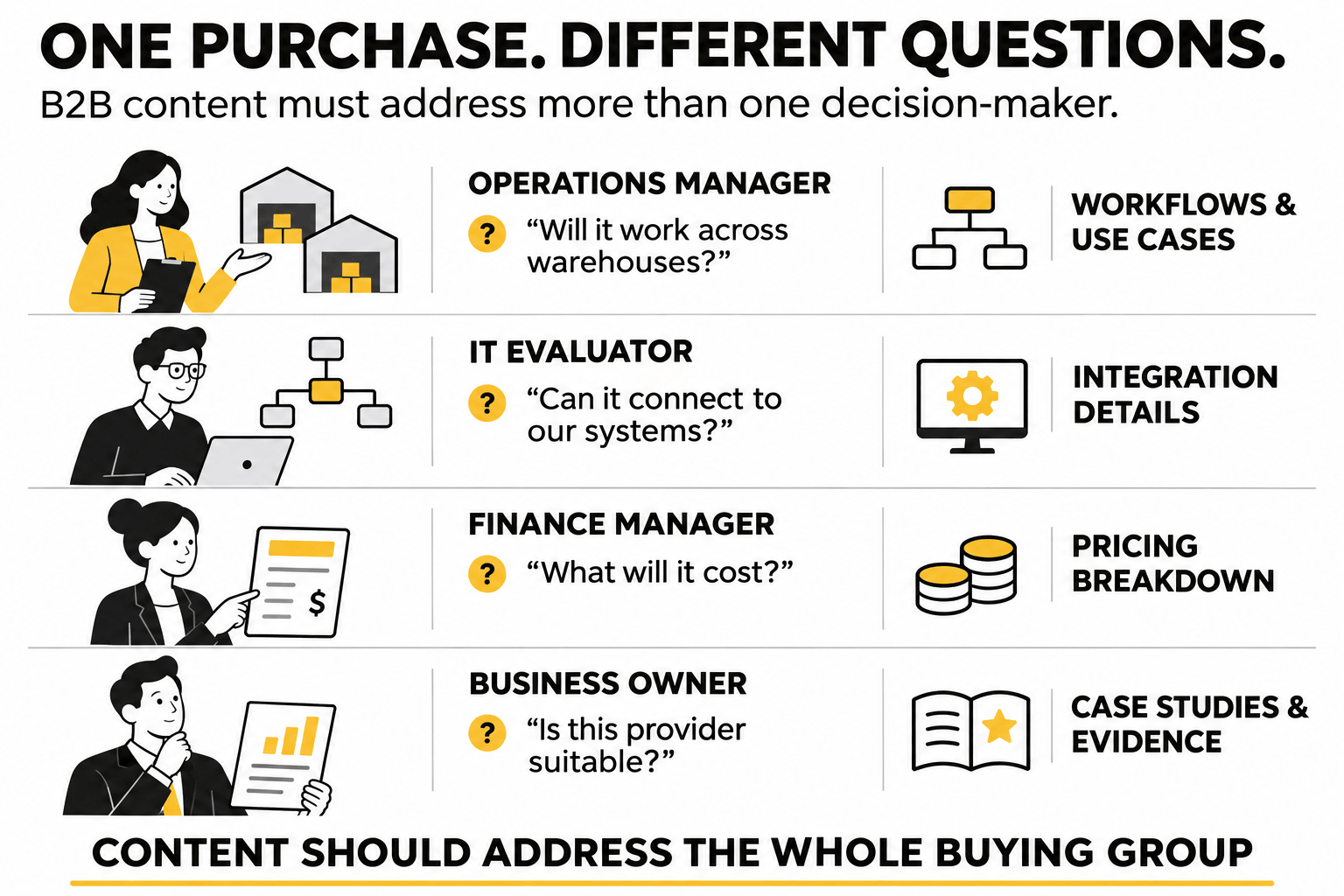
The biggest difference is who needs to be convinced.
With B2C content, you’re often writing for someone making a personal purchase. Business purchases can be more complicated because several people may influence the final decision.
Imagine a Malaysian distributor looking for inventory management software.
| Buyer | What They Want to Know | Content That Helps |
|---|---|---|
| Operations Manager | Will it work across our warehouses? | Workflows and practical use cases |
| IT Evaluator | Can it connect to our existing systems? | Integration details and limitations |
| Finance Manager | What will implementation and ongoing use cost? | Pricing breakdowns and cost considerations |
| Business Owner | Is this provider suitable for our company? | Case studies and supporting evidence |
The operations manager might discover your article, but finance could be the department that delays the purchase. So your content needs to address both.
Of course, smaller purchases don’t always involve a formal buying committee. Still, B2B buyers often need information they can share with colleagues before making a recommendation.
That need for understanding shows up in the research, too. In the 2026 Edelman, LinkedIn B2B Thought Leadership Impact Report, 56% of 1,063 surveyed B2B decision-makers across seven countries said that demonstrating an understanding of their challenges, priorities, and constraints would do the most to increase their trust in a company’s thought leadership.
Although the study focuses specifically on thought leadership, it reinforces a useful writing principle: understand the buyer’s problem before presenting your solution.
Which Types of B2B Content Work at Each Buying Stage?
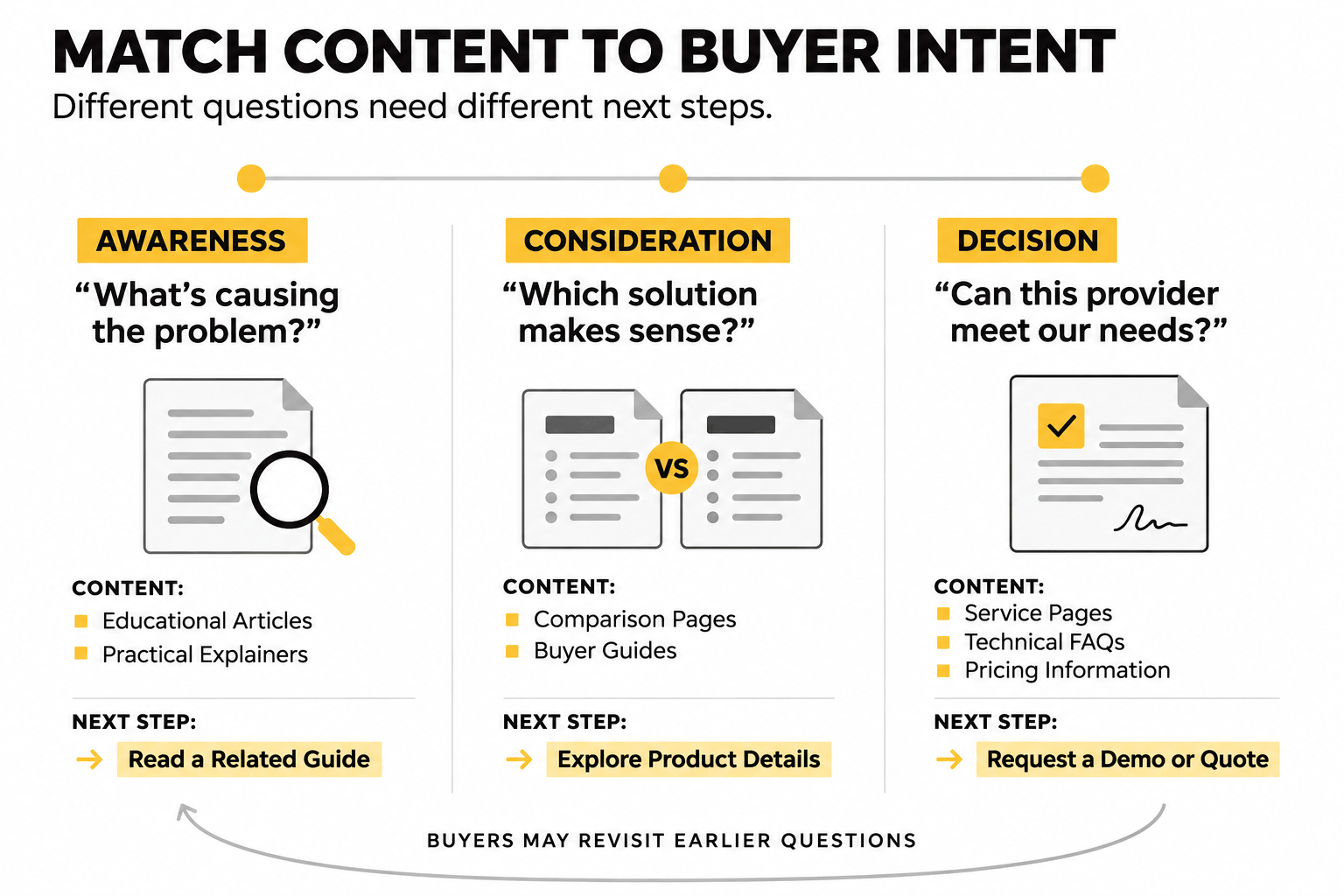
Different questions call for different content.
A buyer trying to understand a problem needs something quite different from someone comparing suppliers. That’s why it helps to plan content around the buying journey.
| Buying Stage | What Buyers Are Asking | Suitable Content | Next Step |
|---|---|---|---|
| Awareness | What’s causing this problem? | Educational articles and explainers | Read a related guide |
| Consideration | Which solution makes sense? | Comparison pages, buyer guides, case studies | Explore product details |
| Decision | Can this provider meet our requirements? | Service pages, technical FAQs, pricing information | Request a demo or quote |
For example, a warehouse manager might first search for ways to reduce inventory errors.
Later, they may compare inventory software with spreadsheets. By the time they’re ready to contact vendors, they’ll likely want to know about implementation, compatibility, and costs.
These stages aren’t always linear. Buyers may revisit earlier questions, particularly when another department becomes involved.
That’s also why case studies are valuable. A well-documented customer story can give several stakeholders evidence to assess, provided the outcomes are genuine and supported by records.
How to Write B2B Content That Generates Leads
A good B2B content strategy starts with the questions your customers ask before they buy. From there, you can decide which pages to create and what each should accomplish.
1. Get Clear About Who You’re Writing For
Start by defining your ideal customer profile (ICP).
Consider the industries you serve, company size, location, and problems your product can reasonably solve. Then identify the people involved in buying decisions.
For instance, a wholesaler researching inventory software may care about stock accuracy, while its finance manager wants to understand subscription fees and implementation costs.
You can address those questions in separate articles or cover them together when the search intent calls for it.
2. Use Real Customer Questions to Find Topics
Your sales and support teams are good places to start.
Ask what prospects regularly struggle with, which objections delay purchases, and what customers wish they’d understood earlier.
Then check Google Search Console and keyword research tools to see how people search for those problems.
Consider these queries:
- How to track warehouse inventory calls for a practical guide.
- Inventory software vs spreadsheets needs a comparison.
- Inventory management software pricing suggests the reader is evaluating costs.
Although all three concern inventory management, writing one generic article won’t necessarily satisfy them.
For more on matching content with search intent, read our SEO content writing guide.
3. Talk to People Who Know the Product
Writers can’t explain technical capabilities accurately without reliable information.
Before drafting, speak with a product specialist or subject matter expert (SME). Ask what the product does, which requirements it supports, and where its limitations lie.
You should also request documentation, approved specifications, or customer evidence where available.
Research supports the value of relevant content. In the Content Marketing Institute’s 2027 B2B research, 47% of marketers who considered their marketing effective selected content relevance and quality as a contributing factor. The report covers 861 B2B marketers, mostly in North America, rather than Malaysia specifically.
4. Answer the Question Before Explaining Everything Else
Readers shouldn’t have to search through several paragraphs to find the answer they came for.
Start with the main point. Then explain the details needed to understand it.
Instead of writing, “Our advanced inventory solution improves business efficiency,” explain how stock updates are recorded, which systems can connect, and what reports users can access, assuming those features are verified.
Specific details give buyers something meaningful to compare.
Also, make your headings clear enough that someone scanning the page can find what matters to them.
5. Add a CTA That Fits the Reader’s Intent
A call to action should feel like a useful next step.
For someone reading an introductory guide, that could be another article or a checklist. Someone comparing suppliers might benefit from a product specification sheet or demonstration.
However, sending every visitor straight to a contact form can feel premature.
Make sure the CTA leads somewhere relevant and explains what the visitor will receive.
6. Distribute the Content Beyond Your Blog
Publishing is only part of the work.
Share useful insights on LinkedIn, include relevant guides in opted-in email campaigns, and give sales representatives articles they can send when prospects ask specific questions.
For Malaysian businesses, language also matters. Some audiences prefer English, others Bahasa Malaysia, while certain industries may benefit from bilingual content.
Choose based on your customers’ preferences, then keep terminology and factual claims consistent across versions.
B2B Content Writing Examples: Before and After
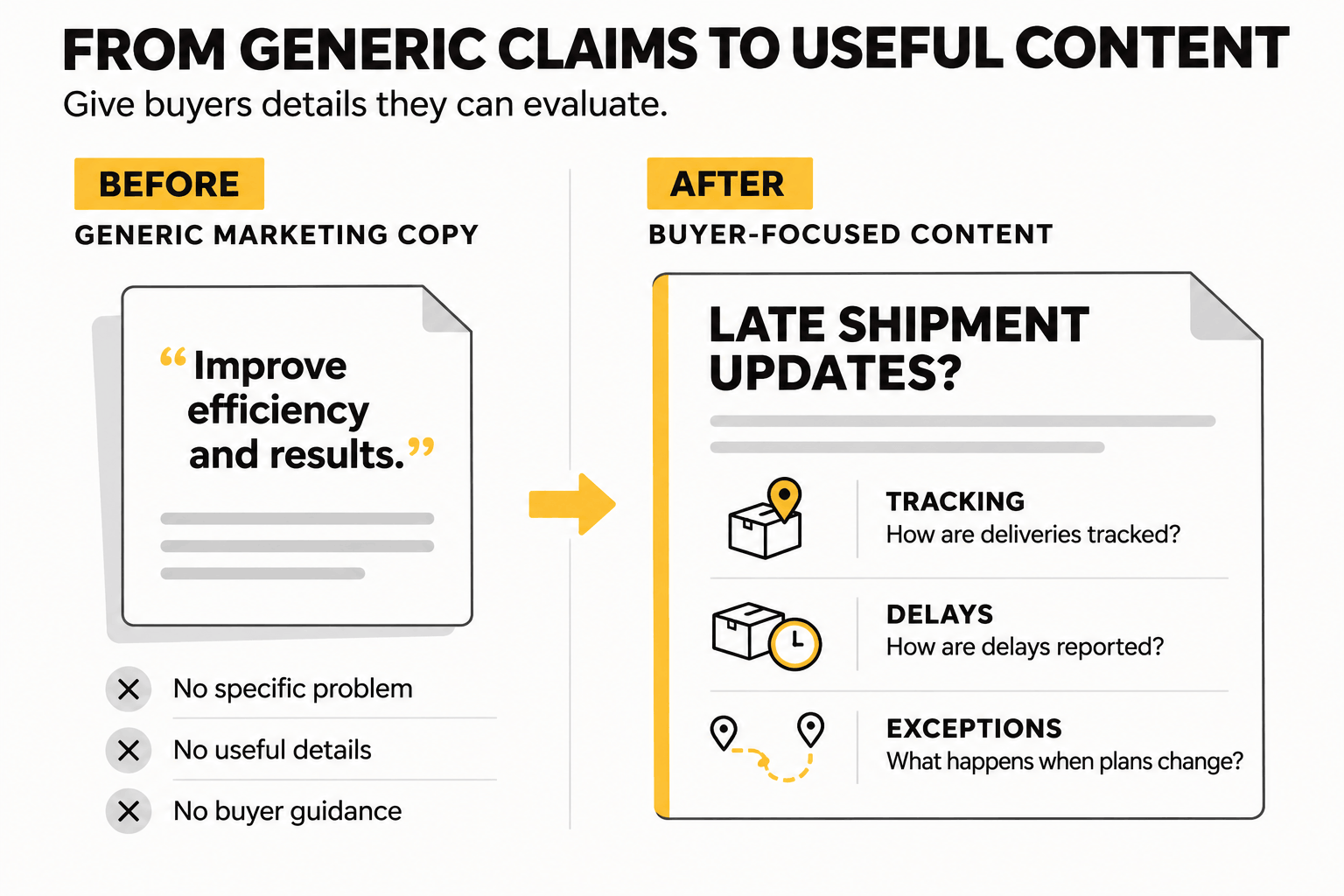
Sometimes a small change in wording makes the content considerably more useful.
Example 1: A Logistics Blog Introduction
Before:
“Logistics is important for every company. The right provider can improve efficiency and deliver better results.”
After:
“Late shipment updates can leave your warehouse team unsure when incoming stock will arrive. Before choosing a logistics provider, find out how it tracks deliveries, reports delays, and handles unexpected changes.”
The second version gives the reader a recognizable situation and practical questions to ask.
Example 2: A Software Case Study
Before:
“Our inventory software saves businesses time and improves performance.”
After:
“A regional distributor manages stock movements using separate spreadsheets, making it difficult for warehouse teams to keep records consistent. The company considers moving to a shared inventory system with a standardized stock-checking process. A case study could then document the implementation and compare reconciliation time and stock accuracy using verified before-and-after data.”
The revised approach provides context rather than an unsupported promise.
For a real customer case study, you’d need evidence of what happened and permission to share the relevant details. Any claimed results should come from actual records.
Example 3: A Comparison Page With a CTA
Before:
“Our inventory system is the best. Book now!”
After:
“Spreadsheets can work for small teams managing straightforward stock records. However, as more people need access to the same information, keeping everything consistent can become harder. Compare your reporting and integration requirements before choosing inventory software. A product demo can help you check whether a particular system fits your workflow.”
The reader gets a fair comparison and a reason to consider the demo.
You’ll find more practical rewrites in our website content writing examples.
How to Turn B2B Content Readers Into Qualified Leads
A visitor isn’t automatically a lead, and a lead isn’t necessarily a good prospect.
Someone downloading a beginner’s checklist may simply be researching. A person requesting a quotation is showing stronger buying intent, although their company might still be outside your target market.
So, before measuring lead generation, agree with your sales team on what qualifies someone for follow-up.
A marketing qualified lead (MQL) generally meets agreed fit and engagement criteria. A sales qualified lead (SQL) has been assessed by sales as ready for direct engagement. The exact definitions should reflect your business.
Then match your conversion opportunities to the content.
Keep basic educational resources easy to access. For a specialized industry report or technical template, asking for contact details might be reasonable, provided the material is worth the exchange.
After someone makes an inquiry, follow up on what they actually requested. Sending a generic sales message can waste an opportunity to continue the conversation.
If you also need support with prospect acquisition and follow-up campaigns, explore our B2B lead generation services in Malaysia.
How to Measure B2B Content Performance
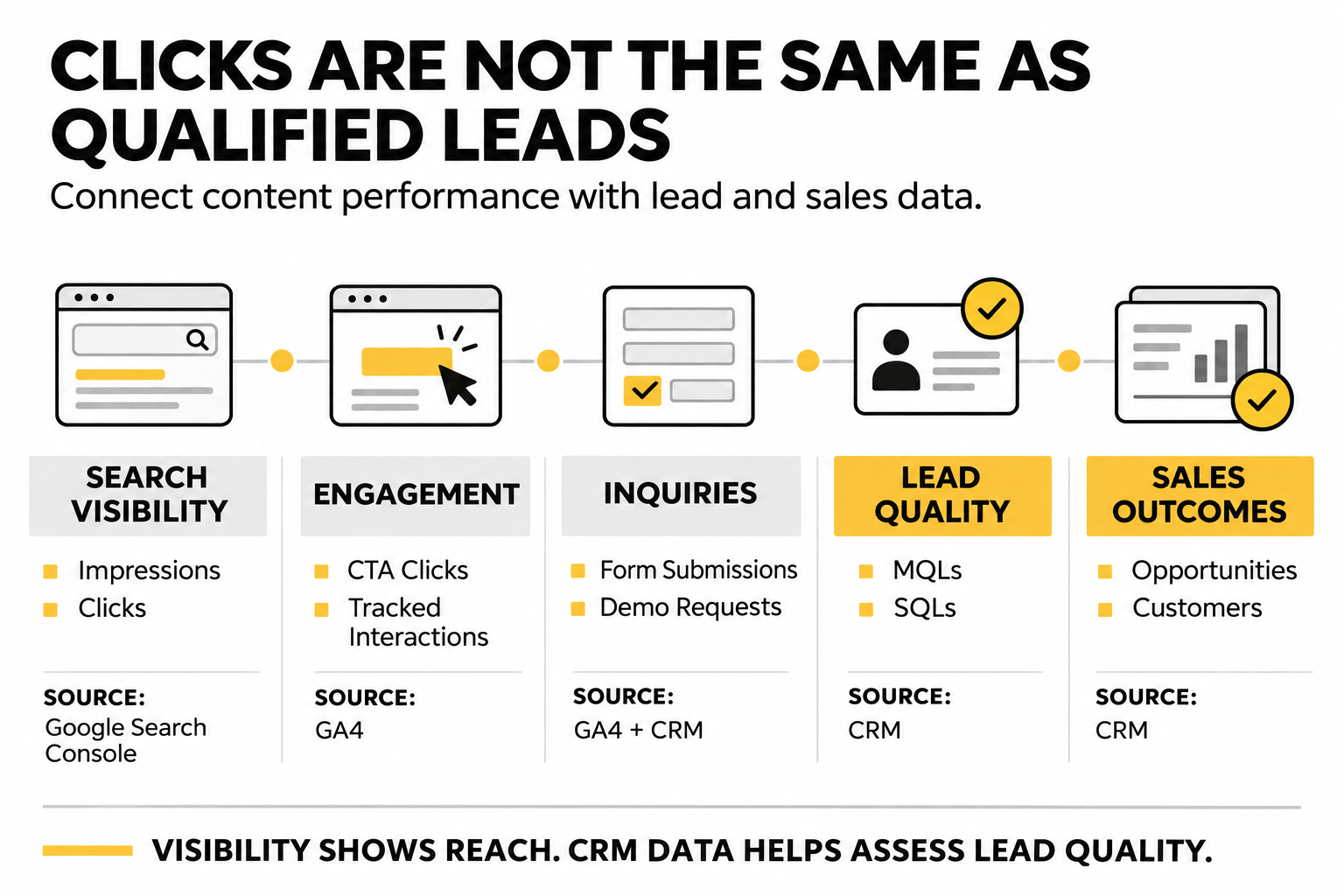
Pageviews can tell you how many visits a page received. They won’t tell you how many suitable businesses became interested in your services.
To get a clearer picture, connect your content reporting with lead and sales data.
| What to Measure | Useful Metrics | Where to Check |
|---|---|---|
| Search visibility | Impressions, relevant queries, clicks | Google Search Console |
| Engagement | CTA clicks and configured interactions | Google Analytics 4 |
| Inquiries | Forms submitted, demo requests | GA4 and CRM |
| Lead quality | Qualified leads, MQLs, SQLs | CRM |
| Sales outcomes | Opportunities and customers | CRM |
For lead tracking, Google recommends GA4 events such as generate_lead, qualify_lead, and close_convert_lead. These are described in its official lead-generation event documentation.
You’ll need to configure the relevant tracking and connect offline lead data where appropriate. GA4 won’t automatically recognize every sales milestone.
Also, don’t expect perfect attribution. A prospect could read your article, discuss it internally, and contact your company later through another channel.
For that reason, review search performance alongside CRM records and feedback from sales.
Should You Hire a B2B Content Writer or Agency?
That depends on how much content you need and how much editorial work your team can manage.
An in-house writer makes sense when content is a regular priority and close collaboration with internal experts matters.
A freelance B2B content writer may suit occasional assignments or a specialized topic. Meanwhile, an agency can help coordinate multiple deliverables, such as blog posts, website pages, and campaign content.
Before hiring, review relevant writing samples and clarify what’s included: research, expert interviews, revisions, SEO work, and publishing support.
Whoever writes the content will still need access to accurate product information and timely feedback from your team.
Frequently Asked Questions
Can AI Tools Write B2B Content?
Yes. AI tools can assist with research organization, outlines, first drafts, and editing. However, technical details, research findings, and customer claims still need verification. For specialized topics, a knowledgeable human reviewer should approve the final copy.
How Long Does B2B Content Take to Generate Leads?
There’s no standard timeline. Organic search results depend on competition, website visibility, and how well the content matches search intent. Distribution through existing audiences may bring earlier visits, but neither approach guarantees inquiries.
What’s the Difference Between a B2B Content Writer and a Copywriter?
A B2B content writer generally focuses on informative material such as articles, guides, and case studies. A copywriter often concentrates on persuasive content, including ads, sales emails, and landing pages. In practice, the responsibilities frequently overlap.
How Much Does B2B Content Writing Cost in Malaysia?
Costs vary depending on research requirements, technical complexity, interviews, editing, and deliverables. Before comparing quotes, check what’s included rather than focusing only on price per word. For a broader breakdown, see our guide to content writing rates in Malaysia.
Need B2B Content That Reaches the Right Buyers?
Start with the questions your customers ask before making a purchase. Then build content that answers those questions clearly and gives readers a useful next step.
The Creatives 360 Malaysia offers content writing services in Malaysia for businesses that need website, SEO, and marketing content.