
For businesses to attract customers, inform them about their services and prompt them to do something, they require words. However, not all business writing serves the same purpose. A website service page, a blog article, and a Google ad may all be about the same business, but they each require a different style of writing.
The key distinction between copywriting vs content writing is the intended effect of each form of writing. They are both important in marketing. Learning the right time to apply each will benefit Malaysian Small and Medium Enterprises (SMEs) business spend their marketing budget more effectively
What Is the Difference Between Copywriting and Content Writing?
Copywriting persuades readers to take action, while content writing focuses on educating them. Both of them have their differences and similarities. But they have their unique place in the marketing process of an organization.
| Comparison | Copywriting | Content Writing |
| Main purpose | Persuade readers to take action | Inform or educate readers |
| Writing style | Persuasive, direct, benefit-focused | Informative, helpful, conversational |
| Main focus | Customer needs and business offers | Customer questions and interests |
| Common formats | Ads, landing pages, sales emails, website service pages | Blogs, guides, articles, educational resources |
| Typical CTA | Buy now, book a call, or request a quote | Read more, explore a guide, or learn more |
| Success indicators | Enquiries, sales, sign-ups, and conversion rate | Organic traffic, engagement, and returning visitors |
What Is Copywriting?
Copywriting is the act of creating messages that motivate people to perform a certain action. Companies use copywriting to market their offerings, sell their value propositions, and convert their prospects into customers.
Good copywriting is more than just describing the business offerings. It explains why the business offerings matter to the customer.
Some common methods of persuasion used by copywriters include:
- Logos: Persuading the reader using logic and facts.
- Ethos: Persuading the reader using credibility, expert knowledge, and evidence.
- Pathos: Persuading the reader by appealing to their needs, concerns, and emotions.
All three methods can be combined to create more compelling messages. For further reading on the topic, check out Purdue OWL’s guide to rhetorical strategies.
Common Examples of Copywriting
- Website copy: Headings, description of services, and homepage copy.
- Landing page copy: Copywriting to prompt visitors to ask for more information or register.
- Advertising copy: Google Ads, social media advertising, and promotional campaigns.
- Email copy: Promotional emails and sales copy.
- Product descriptions: Benefit-driven product descriptions that help make a decision.
- Call-to-action copy: Short calls-to-action like “Get a Free Quote” or “Schedule a Consultation”.
What Does a Copywriter Actually Do?
A copywriter conducts audience research, knows about the business offer, and crafts the messages that motivate audiences to take action.
Their work may include:
- Audience research to understand their pain points and purchasing behavior.
- Knowledge of brand positioning and competitors.
- Crafting effective brand messages and consistent brand voice.
- Copywriting for persuasive headlines, ads, and landing pages.
- Creation of relevant calls to action.
- Message testing and optimization based on performance analysis.
A copywriter also needs to understand where the reader is in the customer journey. The reader who discovers the business for the first time will require a different message than the one that compares service providers.
What Is Content Writing?
Content writing refers to writing useful information that addresses questions and explains certain topics. It is used by businesses to engage audiences and support content marketing efforts.
Unlike sales copy, informational content does not urge the reader to make a purchase right away. Rather, its main goal is to add value first.
Good content writing begins with knowing one’s audience. The writer should think about who the audience is, what they want to achieve, and what information would be useful for them. The GOV.UK guidance on identifying user needs give a good framework that is built on the audience, its task, and the content goal.
- Audience: Who is reading the content and what is their situation?
- Task: What problem are they trying to solve or what action do they want to complete?
- Purpose: What specific information must the page provide so the reader gets a clear answer?
Common Examples of Content Writing
- Blog posts: Articles that address the commonly raised queries by clients.
- Website articles: Informative articles on a certain subject.
- How-tos: Guides that help people perform certain actions or tasks.
- Industry reports: Informed reports that give useful information.
- Email newsletters: Emails that contain helpful information.
- Case studies: Stories about the problems faced by businesses and their solutions
What Does a Content Writer Actually Do?
A content writer does research on various subjects and provides content that is relevant, accurate, and understandable to the target audience.
Their responsibilities may include:
- Researching and finding questions asked by the target audience.
- Knowing about the search intent and appropriate keywords.
- Deciding the structure of articles and creating content calendars.
- Writing blogs, guides, and content for websites.
- Making references related to the subject.
- Using SEO techniques in the content.
- Checking the content for clarity, accuracy, and readability.
A content writer also considers how each article fits into the wider content strategy. A good blog post does not serve only the purpose of filling up a website, it should help users get their questions answered.
Copywriting vs Content Writing Examples: The Same Business, Different Goals
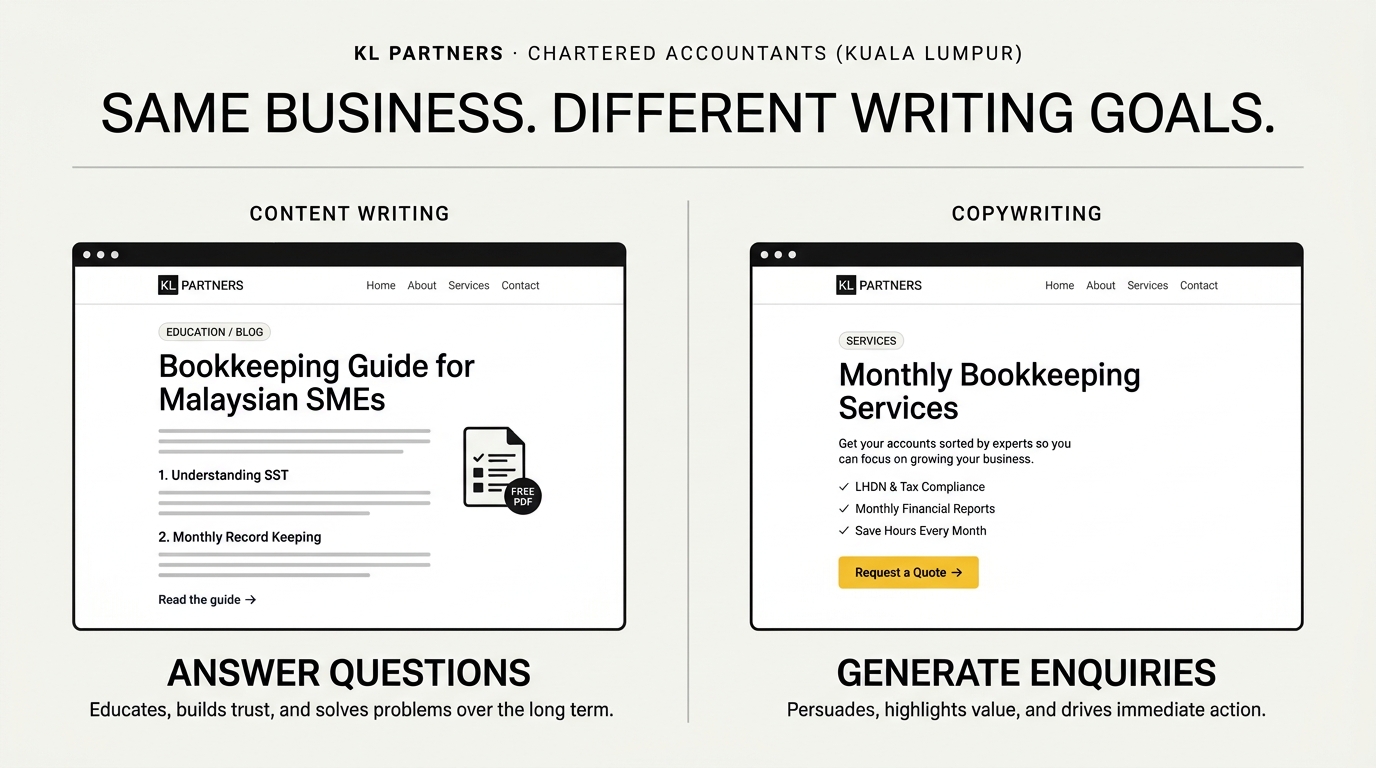
Looking at content writing vs copywriting examples for the same company makes the difference clear. Imagine a licensed accounting firm serving SMEs in Malaysia using both website copywriting vs blog writing to grow its client base.
Content Writing Example: Answering a Customer Question
The firm publishes a blog article titled “A Practical Guide to Bookkeeping Requirements for Malaysian SMEs.” Its goal is to educate business owners who are still researching compliance basics.
- Approach: Explains record-keeping timelines, common accounting mistakes, and required documents in plain language.
- Next step: Links to related guides or a downloadable checklist instead of pushing for an immediate sale.
Copywriting Example: Encouraging an Enquiry
On the same website, the firm runs a dedicated service page titled “Monthly Accounting & Bookkeeping Services in Kuala Lumpur.” This page targets visitors who already know they want to outsource their accounts.
- Approach: Highlights fixed monthly packages, dedicated account managers, and LHDN-ready reporting to support lead generation.
- Next step: Ends with direct calls to action such as “Request a Monthly Quote” or “Book a 15-Minute Consultation.”
How Copywriting and Content Writing Work Together
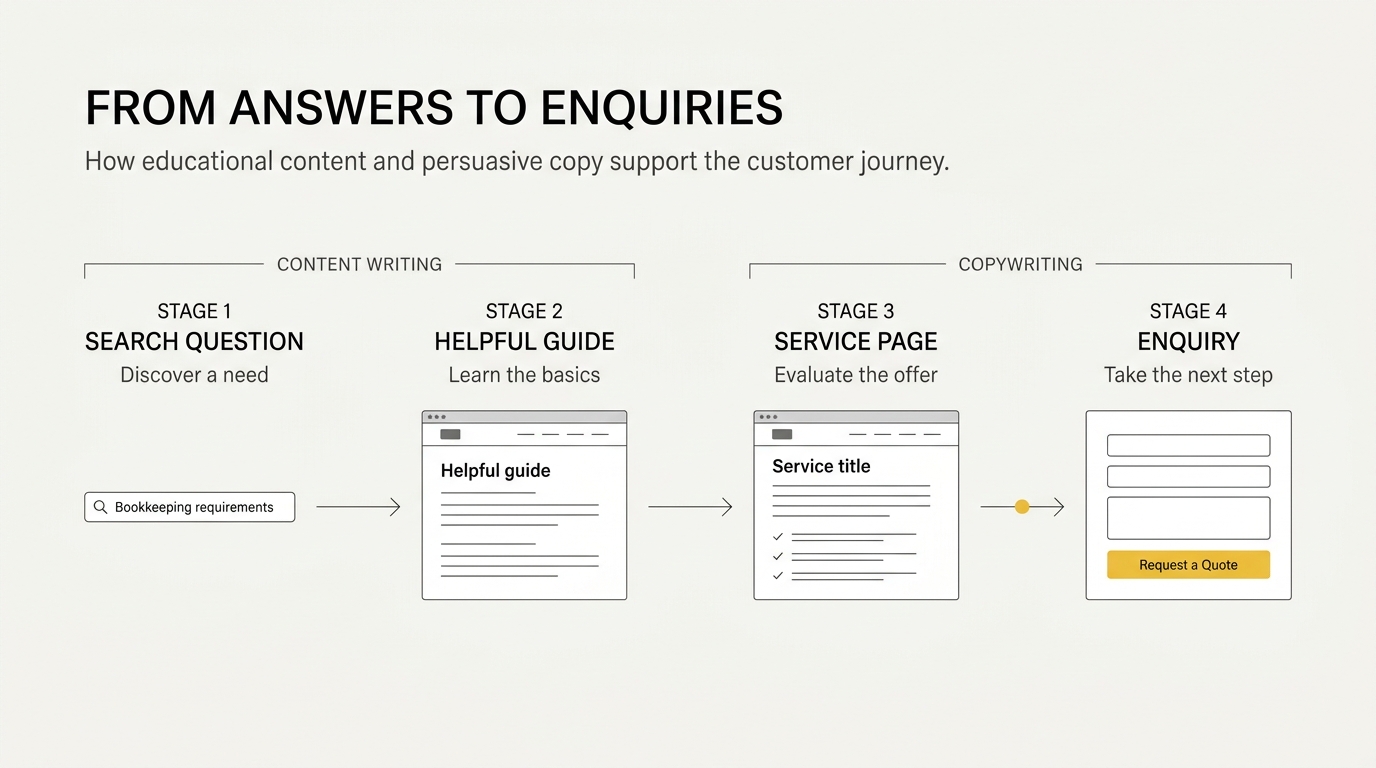
Informational and persuasive writing rarely sit in strict isolation. Even on a single webpage, short pieces of website copy work side by side with longer explanations.
As Nielsen Norman Group’s guide to the 3 I’s of microcopy explains, concise text such as headlines, supporting lines, and buttons can inform users, influence their decisions, or guide an interaction. Across your marketing funnel, blog articles build familiarity first, while service pages and clear microcopy turn that trust into enquiries.
For more practical page breakdowns, review these website content writing examples.
| Writing Example | Primary Objective | Search Intent | Intended Reader Action | Suggested KPI |
|---|---|---|---|---|
| SME bookkeeping guide (blog post) | Educate readers and build organic discovery | Informational | Read the full guide and explore related articles | Organic traffic and engagement rate |
| Accounting service page | Present the offer and generate enquiries | Commercial | Submit a quote request or book a call | Form submissions and conversion rate |
| Google Search ad for accounting packages | Capture high-intent searchers immediately | Transactional | Click through to the landing page | Click-through rate (CTR) and cost per lead |
| Monthly tax reminder newsletter | Stay useful and top of mind with prospects | Informational | Open, read, and reply when help is needed | Open rate and click-through rate |
How Do Copywriting and Content Writing Support SEO?
SEO does not involve just using keywords on the page. The content should be relevant to what people want and give them an experience that adds value.
Google advises making helpful, trustworthy, and user-oriented content rather than content that is optimized for rankings alone. Check out Google’s advice on creating helpful content.
SEO Content Writing for Informational Searches
Content writing for SEO allows companies to reach people who are searching for answers and explanations.
For instance, a company from Malaysia can write on such topics as:
- “How to make financial statements for a small business.”
- “What documentation is required for tax filing?”
- “How does bookkeeping benefit business owners?”
The topics listed above address informational search intent. The content needs to give an answer to the question raised, incorporate keywords, and provide sufficient information.
SEO Copywriting for Commercial Pages
SEO copywriting integrates SEO with marketing. It will help service pages, product pages and landing pages combine the query and the business offering.
For example, a Malaysian business searching for “SEO agency in Kuala Lumpur” may be comparing providers rather than looking for a general explanation of SEO.
The relevant service page should be able to make it clear on the following;
- What they offer.
- Who the agency works with.
- How the services solve customers’ problems.
- Why the solutions are relevant?
- How to contact the agency.
The goal is to help visitors understand the offer and make an informed decision.
Which Does Your Business Need: Copywriting, Content Writing, or Both?
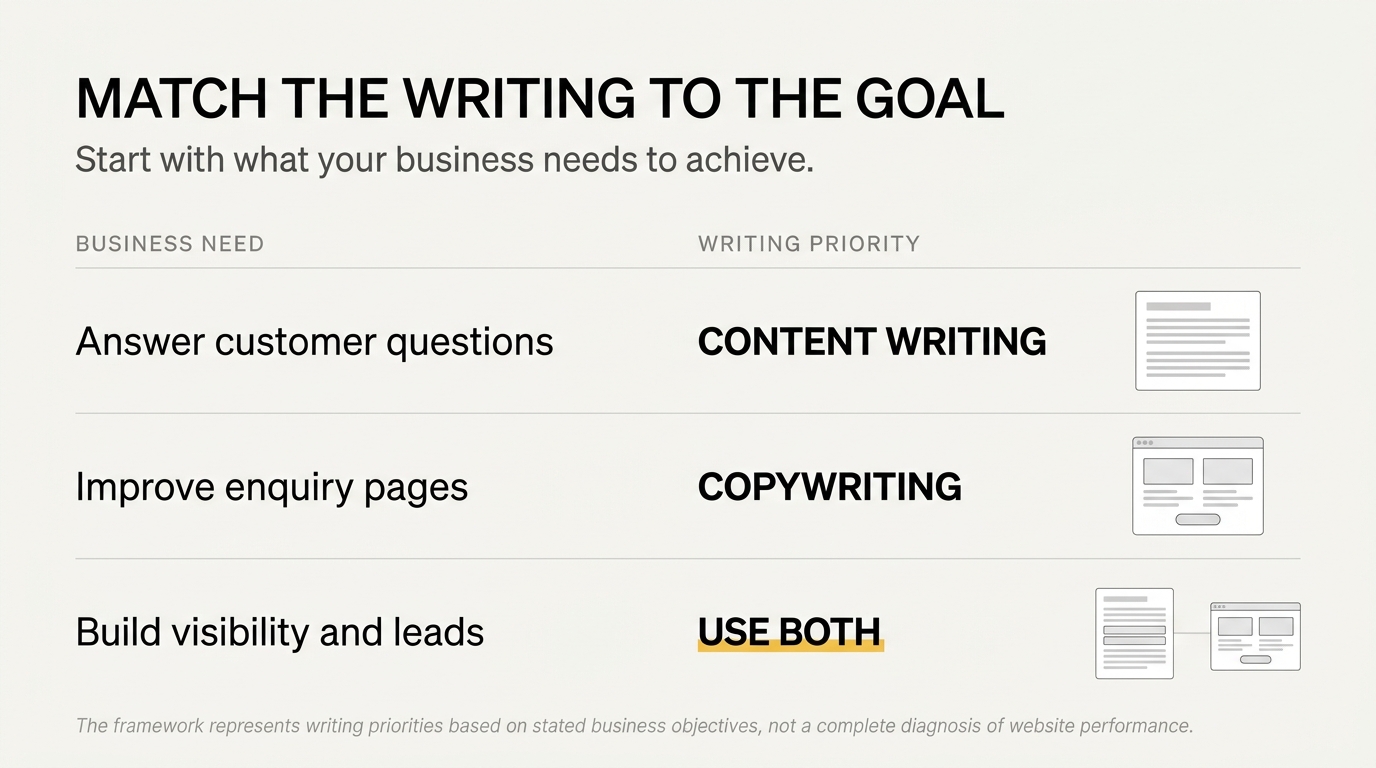
The right choice depends on what you want your business to do right now. If you need to get customers to act, give priority to copywriting. If you need to educate your audience and get traffic to your website, then focus on content writing.
Select copywriting when your business requires customers to make a decision.
It is useful when:
- You have a new product or service offering.
- Your site attracts traffic but gets few inquiries.
- You are advertising via Google Ads or social media.
- You require better sales or landing pages.
- You need to clarify the message for your business offer.
Content writing will suit you well if you want to address customer queries, improve organic reach, and create trust.
It is helpful when:
- Your company needs to attract visitors via Google Search.
- Customers tend to ask questions related to your industry.
- You have complicated products or services.
- You require educational material for your audience.
- You want to develop a content marketing strategy.
Both methods are advantageous for most firms. Content writing captures the attention of prospective clients, while copywriting makes them comprehend the offer. If you need assistance in both areas, explore professional content writing services in Malaysia.
How Should You Measure Copywriting and Content Writing Performance?
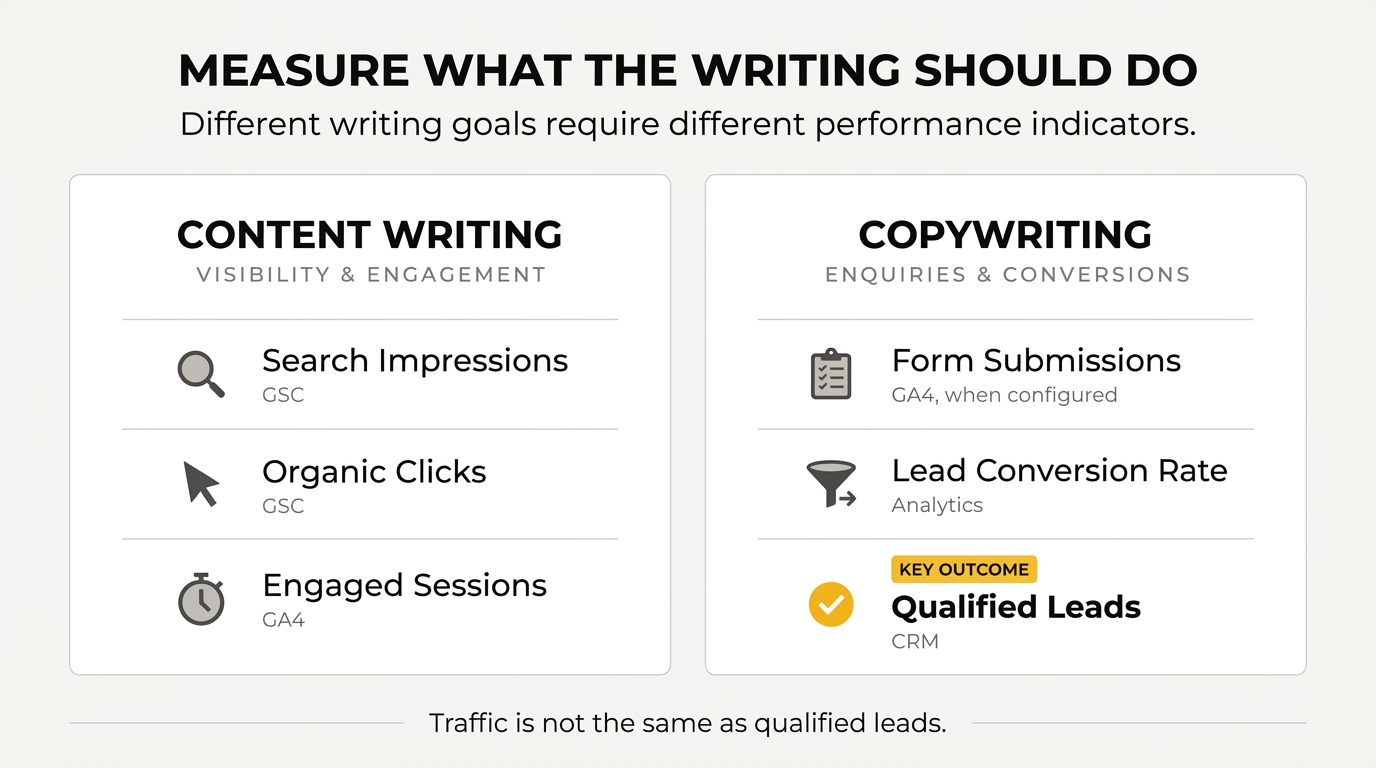
Measure each format against Key Performance Indicators (KPIs) that match its actual job. Content writing is tracked through search visibility and reader engagement, while copywriting is evaluated through enquiries, sign-ups, and revenue.
| Writing Objective | Relevant KPIs | What They Indicate | Important Limitation |
|---|---|---|---|
| Improve organic visibility | Impressions, clicks, and search rankings | How often content appears and attracts search visitors | High traffic does not guarantee qualified enquiries |
| Increase content engagement | Engaged sessions and engagement rate | How actively visitors read and interact with the page | Strong engagement alone does not show commercial intent |
| Encourage enquiries | Form submissions and lead conversion rate | Whether visitors complete a contact or quote request | Submission volume does not reflect lead quality |
| Improve advertising performance | Click-through rate (CTR) and cost per conversion | How well ad copy attracts relevant clicks and actions | Results also depend on targeting, bidding, and landing page UX |
| Generate sales | Purchases and attributed revenue | Whether copy contributes directly to closed transactions | Multi-touch journeys can undercredit earlier educational content |
Two core platforms help you monitor these numbers reliably:
- Google Search Console: Shows search impressions, clicks, average positions, and which queries bring visitors to your pages.
- Google Analytics 4 (GA4): Tracks on-site engagement and business actions using recommended events such as
generate_lead(when a visitor submits a lead) andqualify_lead(when a lead meets your sales criteria).
Keep in mind that lead events are not tracked automatically in every GA4 property and require proper setup. Refer to Google’s GA4 recommended events documentation when configuring conversion tracking.
What Should You Check Before Hiring a Copywriter or Content Writer?
Before you hire a writer, set the goals for the content that you need. It will help you pick the right expert and avoid spending money on irrelevant content.
Here is the checklist to use before you make a choice:
- Define the primary business goal
- Define the target audience
- Define the format of the writing
- Check the writing samples
- Check the expertise in the market research requirements
- Define the brand voice and language requirements
- Set the SEO and search intent expectations
- Set the deliverables and number of revisions
- Define who will check the facts and approve the work
- Set the proper performance indicators
Price is also an important factor. The price might depend on the depth of the research, length of the content, level of technical complexity, and expertise of the writer. Before you compare the quotations, read our article about the content writing rates in Malaysia.
What Information Should You Include in a Writing Brief?
A good writing brief provides the writer with the necessary information for creating relevant content without any further clarifications. It must contain information on the business objective, target audience, topic, required format, and expected result.
| Brief Field | To be provided | Why It Matters |
| Business overview | Company background, products, and services | Helps the writer understand the business |
| Main objective | Traffic, enquiries, sales, or awareness | Determines the writing approach |
| Target audience | Customer type, industry, and location | Makes the content relevant to readers |
| Topic or subject | Main topic and key points to cover | Keeps the content focused |
| Keywords | Primary and secondary keywords, if applicable | Supports search relevance |
| Search intent | Informational, commercial, or transactional | Matches content to what readers want |
| Brand voice | Preferred tone, style, and terminology | Keeps communication consistent |
| Competitor references | Relevant examples and competitor URLs | Shows the expected direction and market context |
| Internal and external links | Pages or trusted sources to reference | Supports navigation and research |
| CTA | Desired reader action | Gives the content a next step |
| Deliverables and deadline | Format, length, submission date, and revisions | Sets clear project expectations |
Even a simple document with these details can make the writing process more organised and efficient.
Frequently Asked Questions
How do I start content writing?
Select a topic to write about first. Secondly, learn about the needs of your target audience. Lastly, practise crafting helpful pieces of information on that topic.
What are the 7 types of content writing?
The most common types of content writing include blog posts, website articles, article writing, SEO writing, copywriting, technical writing, and social media content.
How to learn SEO copywriting?
Understand how to use keywords and how to meet the search intent of the reader. In addition, learn persuasive writing techniques.
How do you start persuasive writing?
Find out the needs of your potential readers. Understand the problems they face and what their needs and expectations are. Then sell them the benefits and end with a call to action.
Is AI replacing copywriters?
No, AI only assists writers with research and drafts.
What do you mean by content marketing?
Content marketing is the process of creating and distributing helpful content to a target audience with the goal of increasing visibility and creating a pool of potential customers.
Need Help With Website or SEO Content for Your Business?
The first thing that you should know is the difference between copywriting and content writing. After that, you will have to select the content that is appropriate for your audience and website.
The Creatives 360 Malaysia offers you professional content writing services in Malaysia. If you require SEO blogs, website content, or any other informative article, we can help you plan content according to your business goals.
Check out our content services and tell us what kind of content your project requires.