

Many business websites publish a blog post every week and still get barely any visitors from Google. The issue is rarely effort. More often, the content covers what the business wants to say instead of what a customer actually searched for.
So, what is SEO content writing? SEO friendly content writing is the process of creating web content that answers a specific search query clearly and is structured so search engines can understand it. Put simply, it combines useful writing with on-page SEO, such as clear headings, natural keywords, and a logical page structure, so the right readers can find the page and get what they came for. That is the meaning of core SEO content writing: people-first content that is also easy for search engines to interpret.
Why Does SEO Content Writing Matter for Businesses?
SEO content writing matters because it helps a business appear when people are actively searching for answers it can provide. Instead of interrupting people with ads, it meets them at the moment they have a question, which makes it a dependable way to build organic traffic over time.
1. Improve Organic Search Visibility
A page that targets a relevant search question can become eligible to appear in Google Search results, and that is the first step toward earning clicks. Organic listings on search engine results pages (SERPs) are unpaid, so unlike paid advertising, visibility doesn’t disappear the day a budget stops.
Writing alone does not guarantee visibility, though. Technical health, competition, and site authority all play a part. If your posts are not getting traction, this guide on why your website is not ranking on Google explains the usual causes.
2. Attract Visitors With Relevant Search Intent
The right audience matters more than a bigger audience. Take an accounting firm in Penang. “Accounting” is a broad keyword that draws students and job seekers. “How to choose an accountant for a small trading company” comes from someone close to a decision. Content built around the second query attracts readers with genuine commercial intent.
3. Build Trust by Answering Customer Questions
Customers research before they make contact. Clear explanations, practical examples, and supporting evidence help them judge whether your business understands their problem. These are the same qualities Google’s quality guidelines describe as E-E-A-T. Trust doesn’t automatically raise rankings, but credible, people-first content gives readers a reason to stay and get in touch.
4. Support Leads and Conversions
Educational content can guide readers to the next step. Someone learning how to choose a supplier can be directed, through a contextual internal link and a relevant CTA, to the service page that fits that decision. Conversions still depend on the whole user journey, including page speed, offer clarity, and the service page itself, not just article optimization.
How Does SEO Content Writing Work?
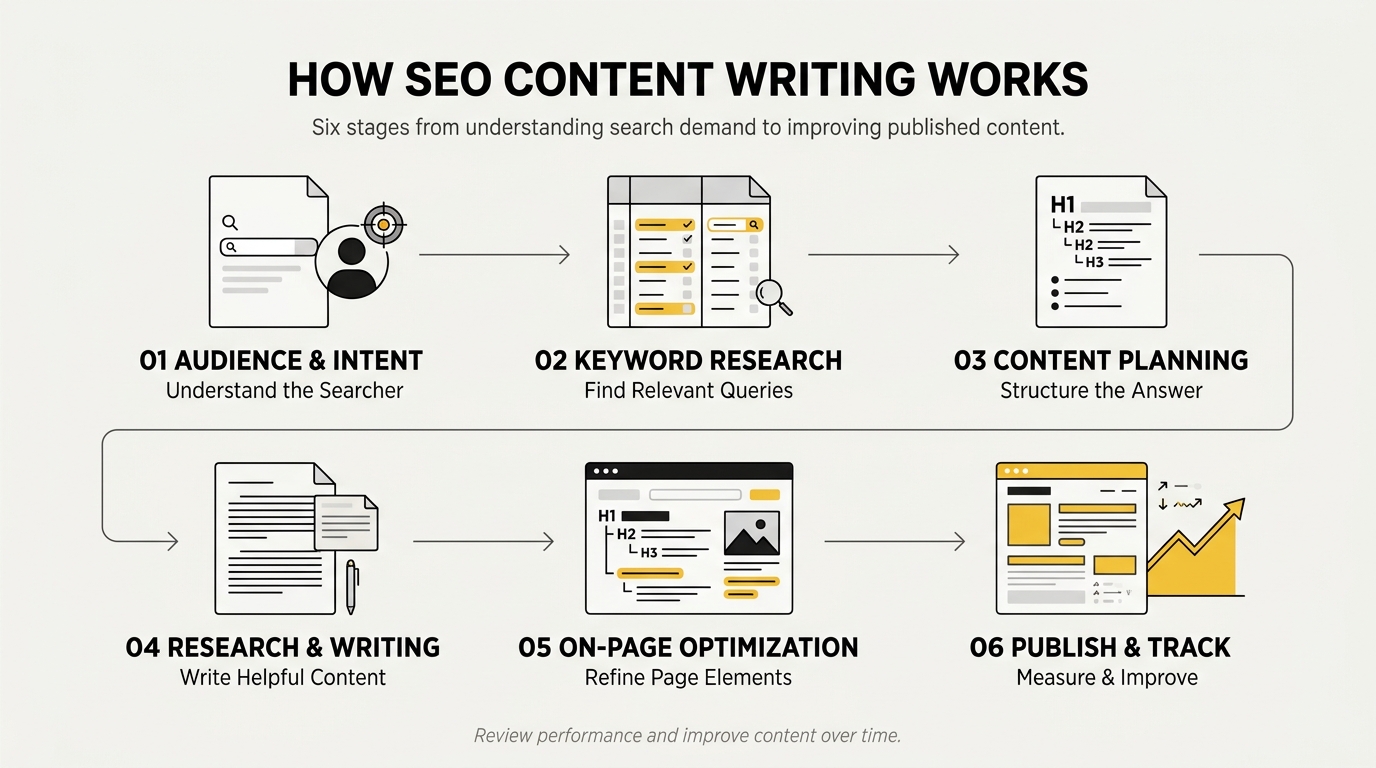
SEO content writing works in a repeatable sequence: find out what your audience is searching for, plan and write content that answers it, optimize the page, then track results and improve. It sits inside broader SEO services in Malaysia, but it is the part your readers actually see.
Audience & Search Intent
↓
Keyword Research
↓
Content Planning
↓
Research & Writing
↓
On-Page Optimization
↓
Publishing & Tracking
1. Understand the Audience and Search Intent
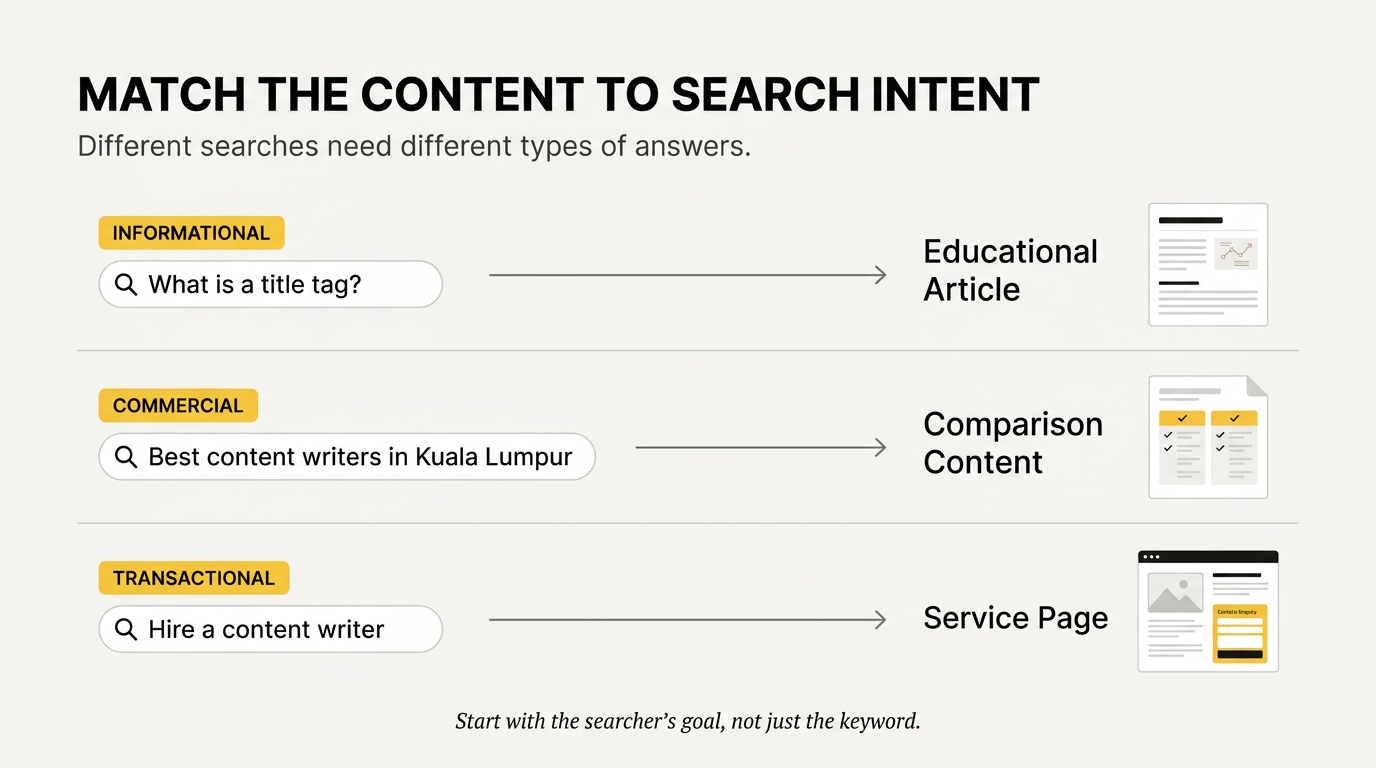
Every search has a goal behind it. “What is a title tag” is informational intent: the person wants to learn. “Best content writers in Kuala Lumpur” is commercial intent: they are comparing options. “Hire a content writer” is transactional: they are ready to act. An informational query usually needs an explanatory article, not a promotional service page, because a sales pitch doesn’t give the searcher what they asked for.
2. Research Relevant Keywords and Search Results
Start with a primary topic that fits your audience’s needs, then list closely related queries and subtopics. Review the current search results to see which formats appear and which questions are still poorly answered. High search volume alone isn’t enough. A popular keyword that doesn’t match your audience brings visits that never turn into enquiries.
3. Create a Clear Content Outline
Match the outline to the searcher’s main question and use descriptive headings. Put the most important answer early, and plan your examples, comparisons, and supporting evidence before drafting.
4. Write Helpful, Relevant, and Original Content
Answer the question first, then add detail. Use specific examples and reliable sources, and let keywords fall into place naturally. Skip filler, unsupported claims, and reworded copies of competitor pages. Google’s guidance on creating helpful, reliable, people-first content stresses originality, accuracy, and real value for readers. Careful editing matters here, and an expert review helps when the topic needs specialist knowledge.
5. Optimize the Content for Search Engines and Readers
Google’s SEO Starter Guide covers the core on-page SEO practices:
- A descriptive title tag
- A clear H1 and logical headings
- Natural keyword usage
- A relevant meta description
- Internal links with descriptive anchor text
- Relevant image alt text
- A readable content structure
A meta description mainly helps communicate page relevance in search snippets. It is not a direct ranking guarantee. For internal linking, Google explains why crawlable links with descriptive anchor text help both users and search engines find related content.
6. Review, Publish, and Measure Performance
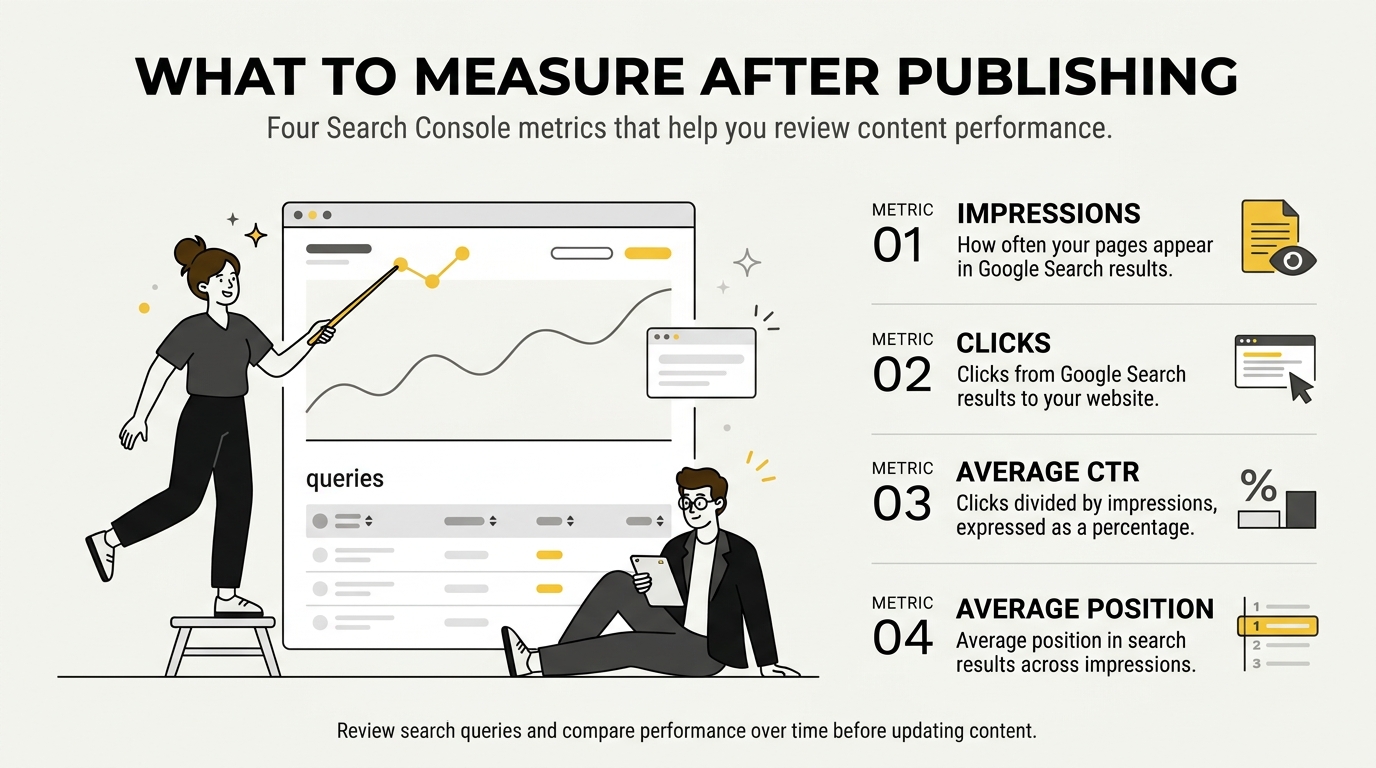
Before publishing, check facts, readability, grammar, and links. Make sure the page is accessible and indexable where appropriate. After it goes live, the Search Console performance report shows clicks, impressions, average CTR, search queries, and average position. Review those numbers over time and improve the page based on what they show. Writing and optimization are ongoing work, not a one-time task.
SEO Content Writing Example: Before and After
Good SEO content addresses a specific search need instead of simply repeating a service keyword. A side-by-side comparison shows the difference clearly.
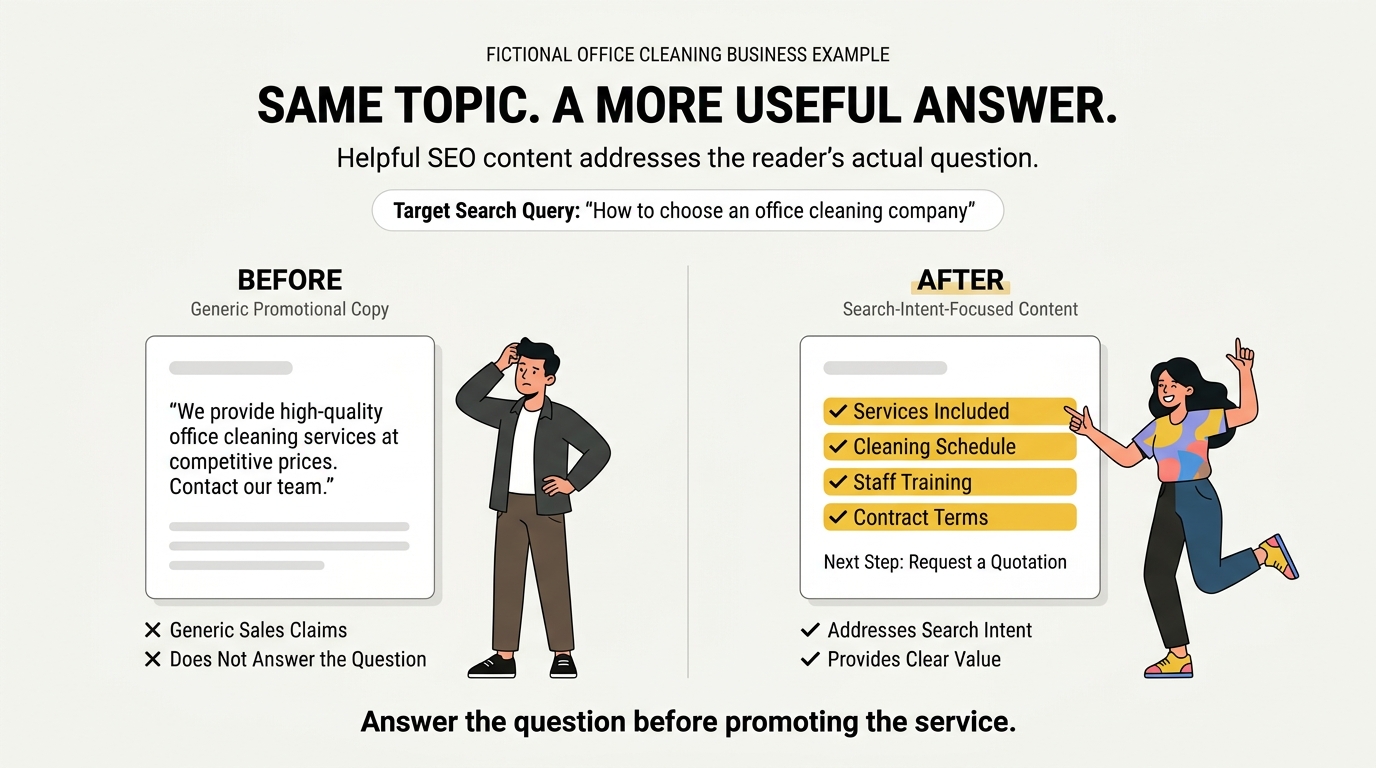
The example below is fictional and for illustration only. A business in Kuala Lumpur provides office cleaning services, and the illustrative target query is “how to choose an office cleaning company.”
Before: Generic Content
We provide high-quality office cleaning services at competitive prices. Contact our team for the best cleaning solutions.
After: Search-Intent-Focused Content
Choosing an office cleaning company involves more than comparing prices. Businesses should review the services included, cleaning schedules, staff training, and contract terms before requesting a quotation.
The second version is more useful because:
- It responds to the information the searcher is looking for.
- It gives practical decision criteria the reader can act on.
- It avoids unsupported promotional claims such as “best” and “high-quality.”
- It creates room for a helpful checklist and a relevant service-page link.
| Element | Before | After |
| Search intent | Ignores the question and pushes a sale | Matches a decision-stage, informational query |
| Usefulness | Claims with no detail | Names specific criteria to compare |
| Structure | Two promotional sentences | A direct answer that can grow into sections or a checklist |
| Next-step CTA | Generic “contact our team” | Natural next step, such as requesting a quotation |
The improved version will not automatically rank higher, because rankings depend on many factors. What it does is give the page a real chance of being useful to the reader, and that is what search engines are trying to reward.
Common SEO Content Writing Mistakes to Avoid
Most content problems come from mismatched intent, weak information, or poor execution, not from a lack of keywords. Adding more keywords rarely fixes a page that doesn’t answer the reader’s question. These are the mistakes that cost the most:
- Targeting keywords that don’t match the page’s purpose. A “buy now” page aimed at an informational query attracts readers who wanted to learn, so they leave.
- Repeating keywords unnaturally. Forced phrases make the writing awkward. Use the keyword where it fits, and use related terms for the rest.
- Writing generic articles without useful examples or evidence. If a competitor’s page says the same thing with more detail, yours gives readers no reason to stay.
- Ignoring internal links and relevant next steps. A reader who finishes the article with nowhere to go is a missed opportunity.
- Publishing without checking accuracy or performance. Outdated facts, broken links, and untracked results let a weak page sit unnoticed.
SEO Content Writing Checklist
Run through this checklist before you publish any page. If you can tick every box, the page is in good shape for both readers and search engines.
- The page targets a clear audience and search need.
- The introduction answers the main question.
- The content offers useful, accurate information.
- Headings follow a logical structure.
- Keywords appear naturally.
- Claims are supported where necessary.
- Relevant internal links are included.
- The title and meta description describe the page accurately.
- The next step or CTA matches the reader’s intent.
- Content performance can be reviewed after publishing.
When Should a Business Consider Professional SEO Content Writing?
A business can absolutely write SEO content in-house. Professional support is worth considering when the workload outgrows the time or skills available, for example, when a business:
- Lacks the time to research and publish consistently
- Needs content aligned with search demand and business objectives
- Struggles to turn industry expertise into clear, structured articles
- Needs website pages, blog posts, or landing pages written and optimized consistently
In those cases professional SEO content writing services can support research, production, structure, editing, and consistency, while you keep control of the details only your team knows.
Frequently Asked Questions
1. Is SEO Content Writing the Same as SEO?
No. SEO is the wider practice of improving a site’s search performance, and SEO content writing is the writing part of it.
2. Does SEO Content Writing Guarantee Higher Google Rankings?
No. Rankings depend on competition, site quality, and many other factors. Good content only improves your chances of being found and useful.
3. Can Small Businesses Write Their Own SEO Content?
Yes. With clear audience research and honest, helpful answers, small businesses can do it themselves and bring in help when time runs short.
4. Can AI Tools Be Used for SEO Content Writing?
Yes, for ideas and first drafts. A person should still check facts, add real experience, and edit so the content stays genuinely helpful.
Need SEO Content That Supports Your Business Goals?
Understanding SEO content writing is the first step. Creating consistent, useful content that aligns with search intent takes research, planning, and careful execution.
The Creatives 360° provides content writing services in Malaysia for businesses that need SEO-focused blog articles, website pages, and marketing content.