

To write web page content that ranks and converts, start by identifying your target audience, defining each page’s purpose, and researching what people search for. Organize the content with clear headings, explain your products or services using specific information, and answer the questions visitors need resolved. Then optimize your title, headings, and internal links, add a relevant call to action, and measure results through search traffic and enquiries.
Good website content should help search engines understand your page while giving visitors enough information to make a decision. This guide explains how to write web page content step by step, with practical tips, a planning checklist, and a real-world-style example for Malaysian businesses.
What Makes Good Website Content?
Good website content tells visitors what you offer, helps them decide whether it’s right for them, and shows them what to do next.
Take a headline like “Professional Solutions for Your Business.” It sounds professional, but it could describe almost any company.
Now compare it with “Office Cleaning Services in Johor Bahru.” Visitors immediately know what the business does and where it operates.
The rest of your website copy should be just as clear. People want to know what’s included in a service, how it works, what it costs, and what happens after they enquire.
Trust matters, too. Genuine reviews, accurate service details, relevant project examples, and clear policies give customers more information to base their decisions on.
Each page also has a different purpose. Your homepage introduces the business, service pages explain what you offer, and landing pages usually focus on a specific offer or action.
How to Write Web Page Content in 8 Steps
You don’t need years of writing experience to create a useful website page. You do need to understand your customers, know your offer, and organize the information properly.
Step 1. Define the Goal of Each Website Page
Start by deciding what you want visitors to do.
Your homepage might encourage people to explore your services. An About Us page introduces the company and its team. Meanwhile, a service page should give potential customers enough information to decide whether to enquire.
Try completing this sentence:
This page helps [target audience] understand [service or topic] so they can [next action].
For example:
This page helps office managers in Johor Bahru understand our cleaning services so they can request a quotation.
Keep that goal in mind while writing. When a section doesn’t help visitors make a decision or understand the offer, consider moving it elsewhere.
Step 2. Understand Your Audience and Their Questions
Your customers can tell you a lot about what belongs on your website.
Look through sales emails, WhatsApp enquiries, customer reviews, and support messages. You’ll often find questions people ask before they’re ready to buy.
For an office cleaning business, these might include:
- Can your team clean outside office hours?
- What’s included in a regular cleaning visit?
- Do we need to supply cleaning equipment?
- How do we request a quotation?
Answering these questions early can save customers from having to contact you for basic details.
You can also speak with your sales team. They’ll know which concerns come up repeatedly and what information customers need before making a decision.
A detailed buyer persona can help, but it isn’t essential for every page. Start with who you’re writing for, what they need, and what might stop them from enquiring.
For instance, an office manager arranging weekly cleaning may care more about schedules and service coverage than a business owner researching cleaning costs for the first time.
Step 3. Research Keywords and Understand Search Intent
Keyword research helps you find the words people use when searching for products, services, or information.
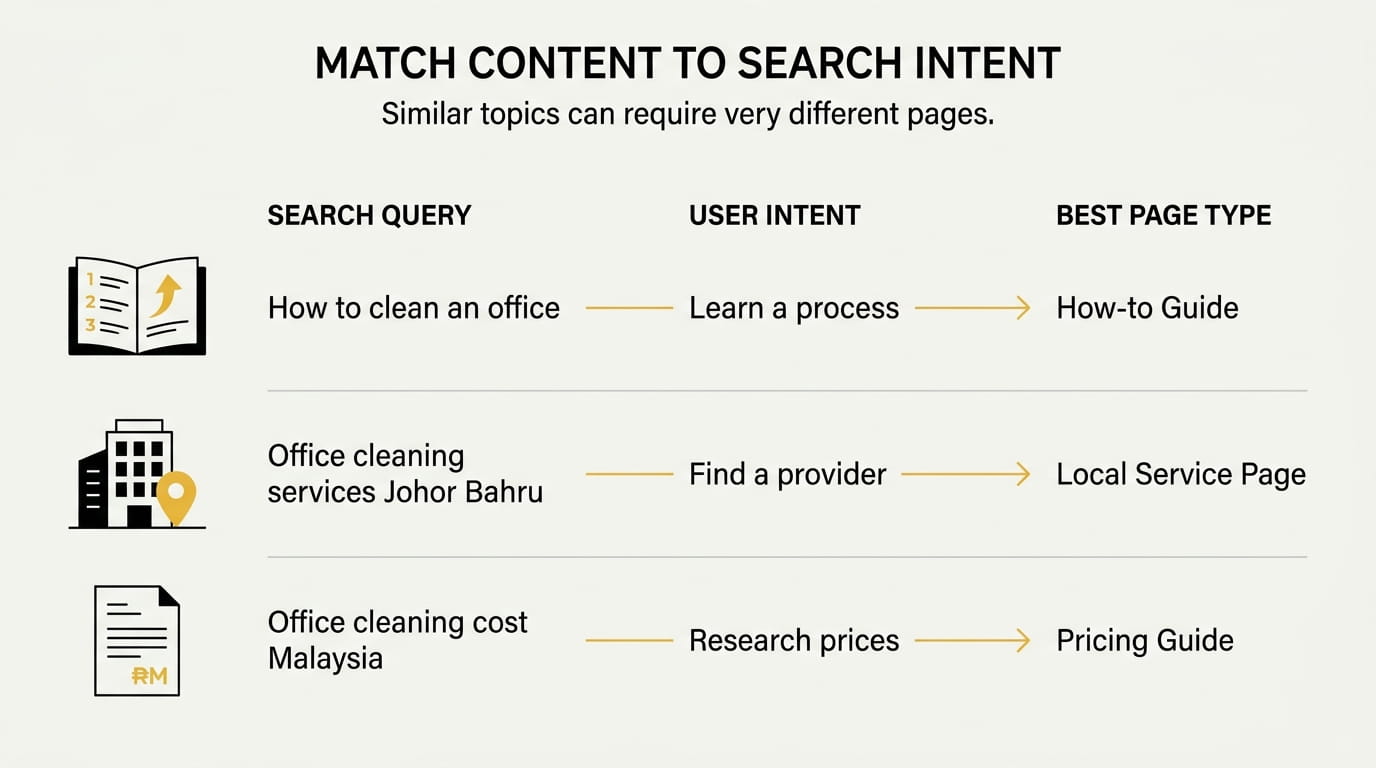
However, similar keywords don’t always mean the same thing. You also need to understand search intent, or what someone expects to find after searching.
| Search Query | Search Intent | Suitable Content |
|---|---|---|
| How to clean an office | Learn a process | How-to guide |
| Office cleaning services Johor Bahru | Find a provider | Local service page |
| Office cleaning cost Malaysia | Research prices | Pricing guide |
Someone searching for office cleaning services in Johor Bahru is likely looking for providers. They’ll want to compare services, confirm the company covers their area, and find out how to request a quotation.
A tutorial on cleaning office furniture won’t answer those questions.
Start with keywords that describe your actual offer. Then review the pages appearing in Google results to understand what information searchers expect.
Choose one main topic for each page and include related terms naturally. There’s no need to repeat every keyword variation or create separate sections for phrases that mean the same thing.
Step 4. Plan a Clear Website Content Structure
Once you know what readers need, decide how to present the information.
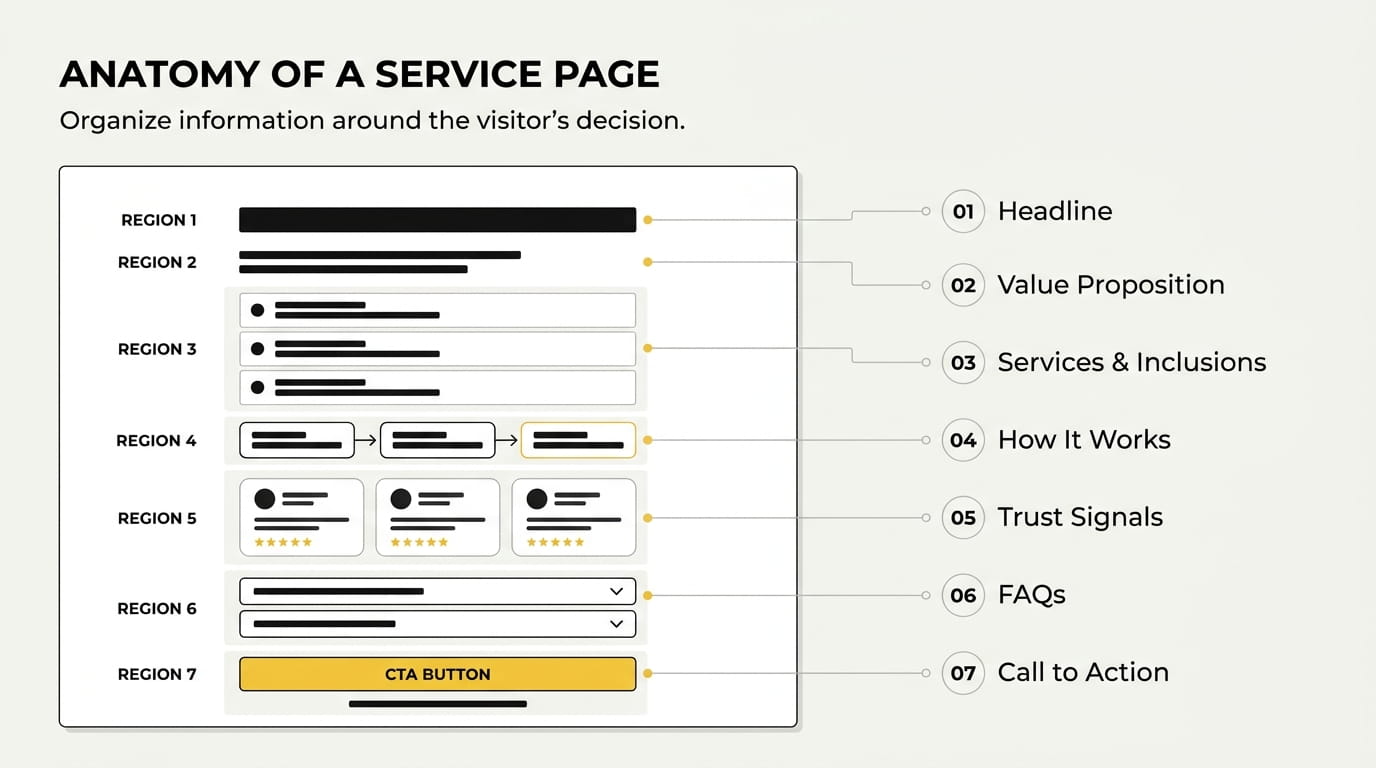
For a typical service page, this structure is a useful starting point:
Headline → Value Proposition → Services and Inclusions → How It Works → Trust Signals → FAQs → Call to Action
Begin with the service and its main benefits. Then explain the details customers need before getting in touch.
Use a clear H1 for the page’s main topic, followed by H2 and H3 headings for supporting sections. A sensible heading hierarchy makes longer pages easier to follow.
Keep paragraphs focused on one idea. Lists work well for service inclusions, while tables can help visitors compare plans, prices, or options.
The structure should fit the service. A straightforward offer may only need a few sections. More complex B2B services often require detailed explanations before customers feel ready to enquire.
Step 5. Write a Clear Headline and Value Proposition
Your headline should tell visitors what the page offers without making them guess.
For a local business, naming the service and location is often a good starting point. The paragraph below can then explain who the service is for and why someone might choose it.
This is where your value proposition comes in.
Think about the difference between a feature and a benefit.
After-hours cleaning is a service feature. Its benefit is allowing employees to work without cleaning activities interrupting their day.
You can use both in your website copy:
Arrange office cleaning outside your regular working hours so your team can focus on work during the day.
Of course, only use that wording when the company actually offers after-hours cleaning.
Benefit-driven copy works best when it’s specific and accurate. Avoid claims such as “Malaysia’s No. 1 Cleaning Company” unless you have reliable evidence to support them.
Step 6. Write Helpful Body Copy and Support Your Claims
Now explain the offer in more detail.
For an office cleaning page, this could mean describing the tasks available, types of workplaces served, scheduling options, and how quotations are prepared.
Keep the language simple. Instead of writing:
We provide comprehensive cleaning solutions tailored to diverse commercial requirements.
Explain what your cleaners actually do and what customers can expect.
Your brand voice should still come through, but it shouldn’t make the message harder to understand. Clear, specific wording is usually more useful than formal marketing language.
Support important claims with evidence where possible. Real customer reviews, project photos, relevant certifications, and accurate service policies are useful trust signals.
Google’s people-first content guidance encourages original, helpful, and reliable content that genuinely serves readers.
Once you’ve written the first draft, go through it again. Remove repeated points, unclear sentences, and descriptions that don’t help visitors understand the offer.
Step 7. Add a Call to Action That Fits Visitor Intent
A call to action (CTA) tells visitors what to do next.
The wording should explain what happens when they click.
For example, “Request a Cleaning Quotation” is more specific than “Submit.”
The right CTA also depends on how ready someone is to act. Visitors comparing providers might want to “View Our Services.” Someone ready to discuss a project may prefer “Contact Our Team.”
Keep your promises accurate. Don’t offer an “Instant Quote” when a staff member needs time to prepare one.
For Malaysian businesses, WhatsApp can also be a practical enquiry channel. A button labelled “Enquire via WhatsApp” tells visitors where they’ll go.
On longer pages, consider repeating the main CTA after important service details. That way, people who are ready to enquire won’t need to scroll back to the top.
Step 8. Review the SEO, Content, and Page Experience
Once your draft reads well, check the on-page SEO.
Start with the title tag, meta description, URL, and headings. Make sure they describe the page accurately and use relevant search terms where appropriate.
Google’s SEO Starter Guide recommends helpful content and a clear website structure. You don’t need to repeat the same keyword throughout a page to make it SEO-friendly.
Internal linking deserves attention, too. Link to relevant services or supporting articles where they help visitors learn more. Google’s link best practices recommend descriptive anchor text that makes the destination clear.
Before publishing, review the practical details:
- Check spelling, grammar, and formatting.
- Confirm service descriptions, prices, claims, and locations.
- Add useful image descriptions where appropriate.
- Test the page on mobile.
- Check that links, buttons, and enquiry forms work.
Strong website content gives visitors useful information, but it won’t guarantee rankings or leads. The site’s technical condition, competition, and the quality of your offer also affect results.
What to Include on Different Website Pages
Learning how to write content for your website becomes easier when you understand what each page needs to accomplish.
Homepage content gives visitors an overview of the business. Service page content explains a particular offer, while landing page copy usually encourages one specific action.
| Page Type | Main Visitor Question | Content to Include | Example CTA |
|---|---|---|---|
| Homepage | What does this business offer? | Main services, value proposition, trust signals | Explore Services |
| Service page | Is this service right for me? | Scope, process, options, supporting proof | Request a Quote |
| About Us | Who runs this business? | Company background, team, experience | Contact Our Team |
| Landing page | Should I respond to this offer? | Offer details, benefits, evidence | Enquire Now |
| Product or category page | Which product should I choose? | Features, prices, availability, delivery details | View Product / Buy Now |
These are starting points rather than fixed templates. Your industry and customer needs will determine how much information each page requires.
For practical samples, explore our website content writing examples, including homepage headlines, service descriptions, and landing page copy.
A Practical Website Content Writing Example for a Malaysian Business
Let’s put the process into practice with a fictional business called Johor Office Care.
The company provides routine cleaning for small offices in Johor Bahru. It wants a service page that explains its offer and encourages relevant quotation requests.
This is a hypothetical writing example, not an actual client project.
Start With a Simple Content Brief
Before writing, gather the information the page needs.
| Planning Item | Example Detail |
|---|---|
| Target audience | Office managers and SME owners |
| Page goal | Generate quotation requests |
| Primary topic | Office cleaning services in Johor Bahru |
| Customer questions | Tasks, schedules, equipment, quotations |
| Service scope | Routine office cleaning |
| Service area | Johor Bahru |
| Supporting proof | Genuine reviews or project photos, if available |
| Main CTA | Request a Cleaning Quotation |
| Success metric | Relevant completed enquiries |
This gives the writer a clear direction without turning a straightforward page into a complicated project.
For a real business, the owner would need to confirm the cleaning tasks, operating arrangements, and supporting evidence before approving the copy.
Turn the Brief Into Website Copy
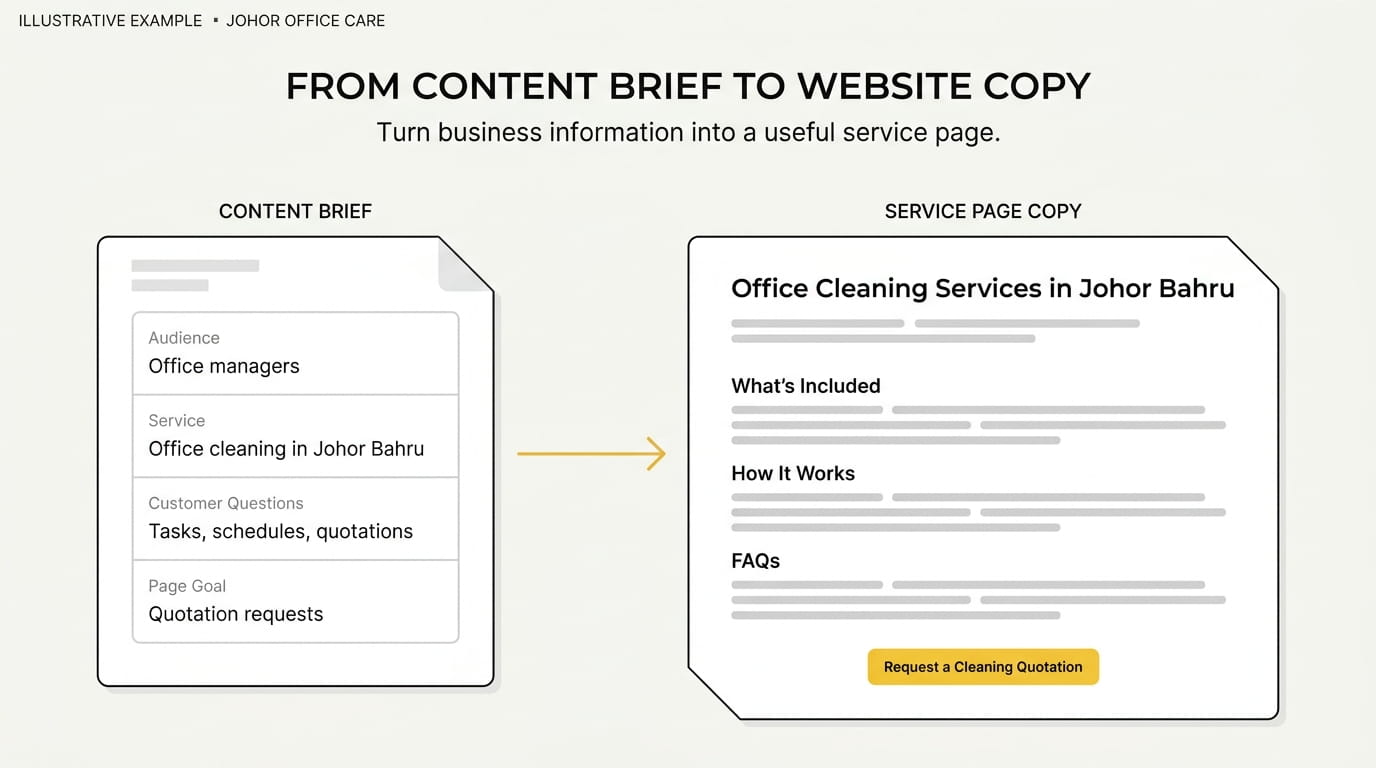
Start with a direct H1:
Office Cleaning Services in Johor Bahru
Then write a short introduction that explains the offer.
Keep your workplace clean with office cleaning services planned around your business needs. Tell us about your premises, preferred schedule, and cleaning requirements so our team can review your request.
From there, the page could follow this outline:
- Our Office Cleaning Services: Explain the types of workplaces served and the cleaning options available.
- What’s Included: Describe confirmed cleaning tasks, available options, and exclusions.
- How It Works: Explain the enquiry, assessment, and quotation process.
- Why Choose Us: Share genuine customer feedback, relevant qualifications, or previous work.
- FAQs and Quotation Request: Answer remaining questions and give visitors a way to enquire.
There’s no need to make every section long. Focus on the information that helps customers decide whether the service suits them.
The sample also avoids unconfirmed promises about pricing or turnaround times. Those details should only appear once the business has approved them.
Review the Draft Before Publishing
Read the page as someone who has never heard of Johor Office Care.
Can you tell what the company offers and where it operates? Are the cleaning options clear? Is it easy to request a quotation?
Then check the page title, headings, keywords, links, and contact form. Any testimonials, certifications, or service claims should be approved before publication.
After the page goes live, monitor which searches bring visitors to it and how many enquiries become qualified leads.
Website Content Writing Tips for Malaysian Businesses
Writing for Malaysian customers means paying attention to language, location, and how people prefer to contact your business.
Choose the Language Your Customers Use
English may suit companies targeting corporate clients, while Bahasa Malaysia may be more appropriate for other audiences. Some businesses benefit from offering both.
Look at customer enquiries, search queries, and your target market before deciding.
For separate English and Bahasa Malaysia pages, Google’s multilingual website guidance recommends using different URLs for each language version. It also explains how hreflang can help Google identify alternate-language pages.
Keep Your Location Details Accurate
If your company only serves Johor Bahru, don’t add Kuala Lumpur, Penang, and Selangor throughout the page simply to attract more searches.
List the places you actually cover, along with accurate contact details. Customers should be able to check your service area before getting in touch.
Common Website Content Writing Mistakes to Avoid
A page can have the right keywords and still leave visitors confused.
Watch out for these common problems:
- Vague headlines: Use the actual product or service name instead of a broad slogan.
- Too much company-focused copy: Explain what customers need before going into your full company history.
- Keyword stuffing: Avoid repeating the same search phrase in every section.
- Missing service details: Tell visitors what’s included, how the service works, and what happens next.
- Unsupported claims: Use verified facts, genuine reviews, and real examples.
- Unclear CTAs: Choose wording that describes the action.
- Similar copy across service pages: Give each service its own information and customer-focused answers.
Fix the issues that affect understanding first. Small wording changes won’t help much when visitors still can’t figure out what you’re offering.
Website Content Checklist Before Publishing
Use this checklist when reviewing a new page or updating an existing one.
-
The page has a clear goal and target audience.
-
The headline explains the offer.
-
Common customer questions have been answered.
-
Service details, prices, locations, and claims are accurate.
-
Headings and paragraphs are easy to scan.
-
Keywords match the topic and search intent.
-
Internal links lead to relevant pages.
-
The CTA explains the next step.
-
The page works properly on mobile.
-
The title, meta description, images, links, and forms have been checked.
One useful test is to ask someone unfamiliar with your business to read the page. Afterwards, ask them what you offer and how they’d contact you.
If they struggle to answer, part of the copy probably needs to be clearer.
How to Measure Whether Your Website Content Works
Publishing your content is only the beginning. You’ll also want to know whether people can find the page and what they do after arriving.
Google Search Console and Google Analytics 4 (GA4) can help you measure different parts of that process.
Track Search Visibility and Enquiries
| Metric | What It Shows | Tool |
|---|---|---|
| Search impressions | How often the page appears in Google Search | Search Console |
| Organic clicks | Clicks from Google Search results | Search Console |
| Search CTR | Percentage of impressions that receive clicks | Search Console |
| CTA clicks | Interactions with tracked buttons or links | GA4 |
| Completed enquiries | Successfully tracked form submissions or lead requests | GA4 |
| Qualified leads | Enquiries that meet your business criteria | CRM, possibly linked to GA4 |
Google Search Console’s Performance report includes impressions, clicks, CTR, and average position.
GA4 also supports lead-related events such as generate_lead and qualify_lead, although these require the right tracking setup.
Measure Leads, Not Only Button Clicks
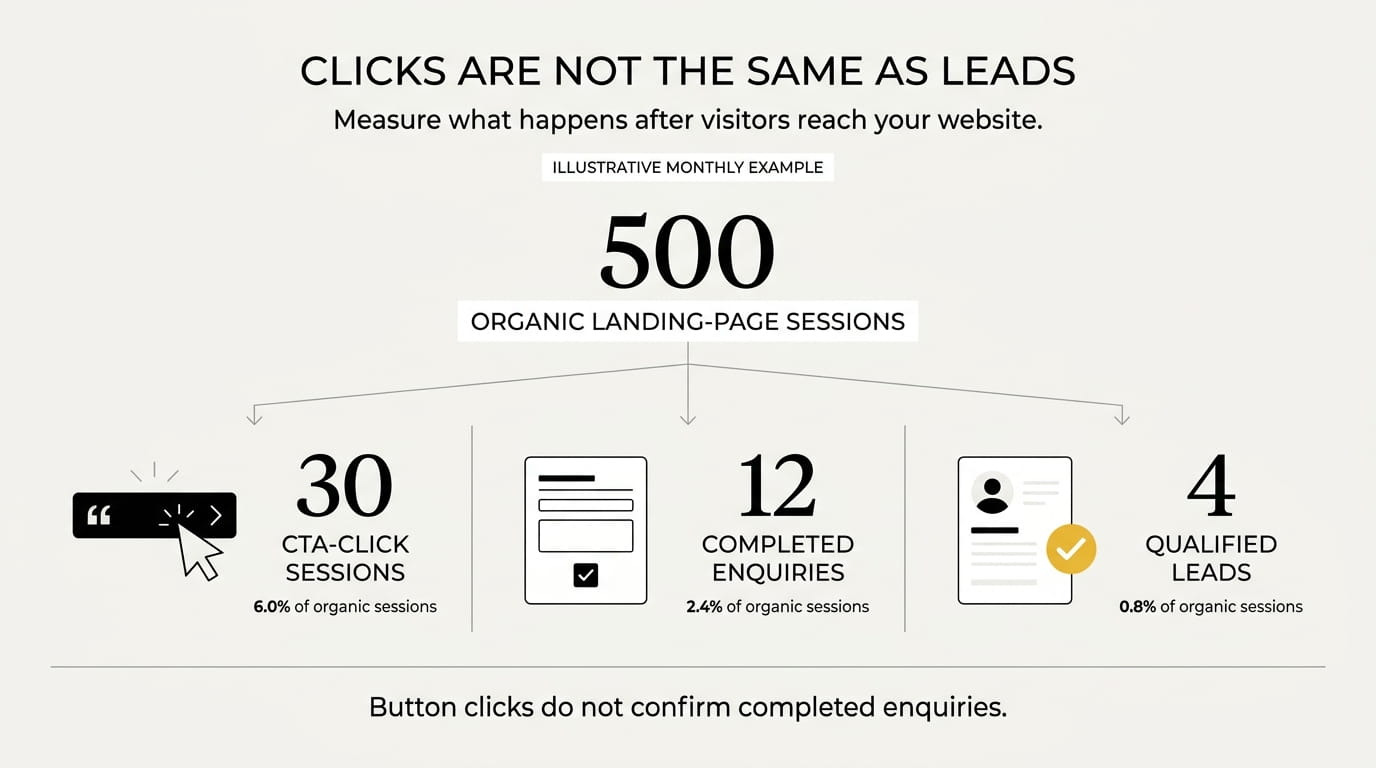
Imagine a hypothetical month where a service page receives:
- 500 organic landing-page sessions
- 30 sessions with a quotation-button click
- 12 completed enquiries
- 4 qualified leads
Assuming all these actions are tracked correctly and attributed to those sessions, the results would be:
- 6% of sessions included a quotation-button click.
- 2.4% resulted in a completed enquiry.
- 0.8% resulted in a qualified lead.
These figures are only an example, not industry benchmarks.
Remember that clicking a WhatsApp button doesn’t mean someone sent a message. Similarly, opening a contact form doesn’t mean the visitor submitted it.
For lead generation, completed enquiries and qualified leads give you a better picture of business results than button clicks alone.
Review performance over time. Seasonal demand, campaigns, website changes, and traffic quality can affect the numbers. An increase in enquiries after rewriting a page is encouraging, but it doesn’t automatically prove the copy caused it.
Should You Write Your Website Content or Hire a Professional?
You can write your own website content, especially when you understand your services and know what customers usually ask.
For a small business website, you may already have most of the information needed for a good first draft. The harder part is often finding time for keyword research, writing, editing, and reviewing every page.
Professional help may be worth considering when you’re building a larger website, updating several service pages, or need a consistent brand voice across different types of content.
Before hiring a writer, agree on the number of pages, research responsibilities, revisions, and final deliverables. Rewriting one service page is a different project from planning and writing an entire website.
For Malaysian businesses looking for support, The Creatives 360 offers website content writing services.
Frequently Asked Questions
How Long Should Website Content Be?
There’s no fixed word count for every website page. A contact page may need only a few short paragraphs, while a detailed service page may require information about options, processes, and customer requirements.
Write enough to answer visitors’ questions without repeating yourself. Google doesn’t have a preferred word count for rankings.
Can I Write Website Content Without SEO Experience?
Yes. Start with accurate information about your business and the questions customers ask.
Then learn the basics of keyword research, page headings, title tags, and internal linking. You don’t need to master every part of SEO before writing your first page.
Should I Write Website Content Before or After Designing the Website?
Start planning your content before the design is finalized.
Knowing what each page needs to say makes it easier to create a layout that fits the information. Writers and designers can then adjust the copy and design together.
How Often Should Website Content Be Updated?
Update your content when something important changes, such as your services, prices, business hours, policies, or customer needs.
You can also use search and enquiry data to find pages that need improvement. Accurate, useful content doesn’t need rewriting simply to make it look recent.
Does SEO-Friendly Website Content Guarantee Higher Rankings or More Leads?
No. Clear, helpful content can make your pages more relevant to search queries and easier for visitors to use.
However, rankings and conversions also depend on competition, technical SEO, website usability, traffic quality, and the strength of your offer.
Need Help Writing Content for Your Website?
Knowing how to write quality content for your website is one thing. Finding the time to research, write, and review every page is another.
The Creatives 360 Malaysia provides content writing services for Malaysian businesses, including website copy, SEO blog articles, and marketing content.
If you’re planning a new website or improving existing pages, explore our services to see what fits your project.